
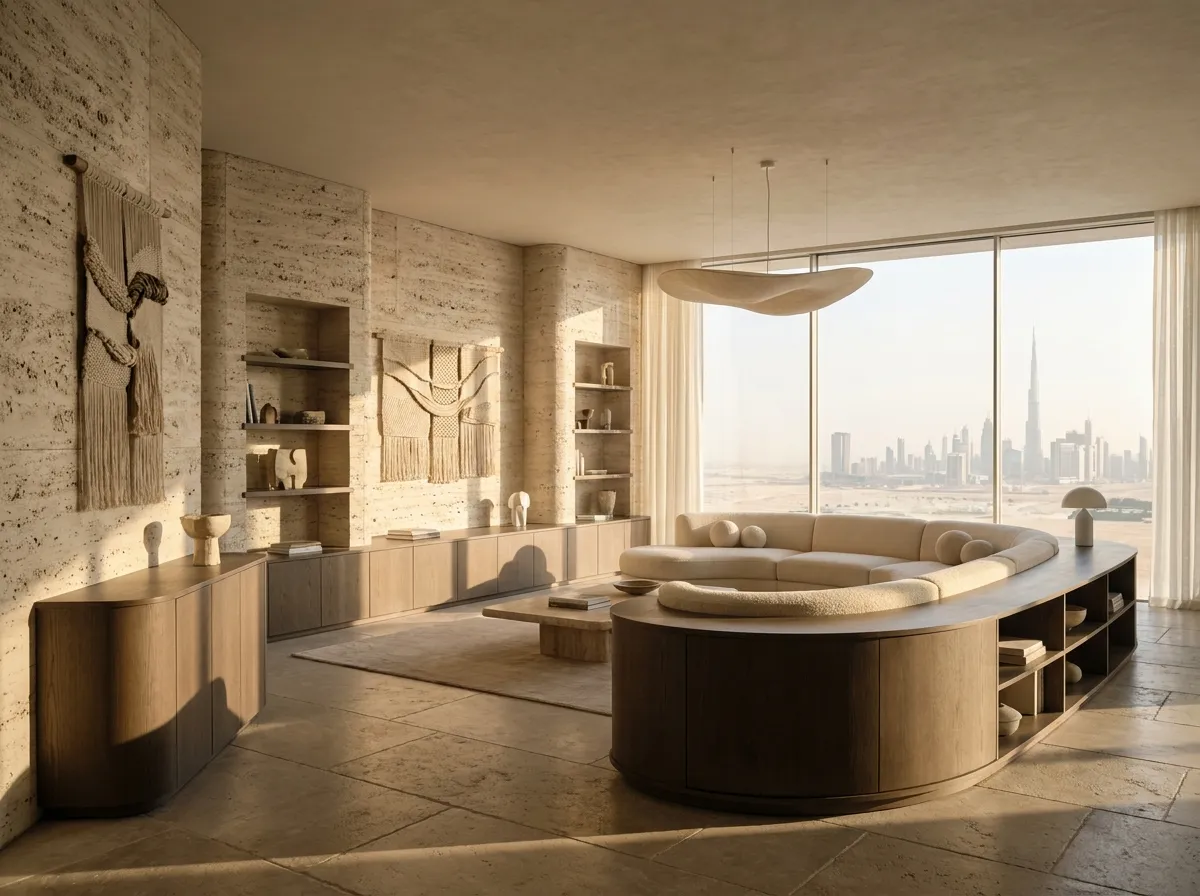
Every significant period in design history has its keynote material. The 1980s were marble and brass at their most declamatory. The 1990s were concrete and steel. The 2000s were glass and mirror, surface without substance. The 2010s brought the Nordic correction: white walls, blonde timber, considered emptiness. Now, in 2026, we are witnessing a return to materiality itself, to the conviction that the inherent qualities of natural substances, their weight, their warmth, their capacity to accumulate character over time, are the most powerful tools available to the interior designer. Textural Depth has become the defining aspiration of luxury interior design globally. In Dubai, where ambition of scale meets a growing sophistication of material understanding, that aspiration is finding some of its most compelling expressions.
Organic Brutalism 2026: A Movement Defined
The term “organic brutalism” embodies a fruitful paradox. Brutality signifies honesty in the use of raw materials, structural expression, and a rejection of aesthetic embellishment. Organicity, on the other hand, evokes warmth, biological richness, and the imperfections of the natural world. In the hands of our most creative designers, these impulses do not appear inherently contradictory. The concept of “Organic Brutalism 2026” describes interiors that combine the structural confidence and raw materials characteristic of great Brutalist architecture, where load-bearing forms are given their full visual weight and surfaces are left to speak for themselves without any decorative mediation, with the warmth and richness of authentic, natural materials. The result is spaces that feel both luxurious and intimate: perhaps the most elusive and desirable quality in interior design.
In practice, organic brutalism is manifested in spaces where thick concrete walls with their exposed formwork and debris give way to hand-polished travertine floors, their rich surface capturing and holding the morning light. Exposed steel structural elements, whether raw or brushed with wire, are complemented by custom-designed smoked oak joints, their warmth balancing the metal’s solidity. The room’s design is bold, angular, and precise, yet the range of materials used is entirely natural: stone, wood, leather, linen, and clay, each surface chosen not for its performance, but for its ability to develop beauty over time. This is the fundamental difference between organic brutalism and pure industrial design: in industrial design, material is an aesthetic stance. In organic brutalism, material is the starting point of its life, the beginning of the process by which a space and its surfaces acquire their full character through use and time.
Material intelligence is the intellectual driving force behind this approach. It is the methodology that determines which raw materials possess the essential qualities, structural integrity, tonal depth, and aging behavior, that meet the aesthetic requirements imposed upon them. Not every stone can be left unfinished without becoming merely an unfinished surface. Not all wood can be brushed with a wire brush without becoming rough. The hallmark of a designer working at the highest level in the Organic Brutalist style is their ability to identify materials with a strong enough natural character to be the design itself, requiring no additions, only appropriate removal and precise adjustment.
Travertine: Two Thousand Years of Relevance and Still Evolving
Travertine has been used in architecture for more than two millennia. The Colosseum is built from it, which ought to settle the question of its structural credentials. But its current renaissance in luxury interiors represents something considerably more specific than a return to classicism. The travertine of 2026 is not the polished, filled, mirror smooth stone of 1980s hotel lobbies. It is something altogether more honest and more alive, honed, brushed, or tumbled to expose the stone’s natural porosity, its characteristic voids, formed by gas bubbles trapped in the original mineral deposit millions of years ago, left open rather than filled, because those voids are precisely where the material’s most distinctive Textural Depth resides.
In a Luxury Mansion Fit Out Dubai context, travertine is appearing in applications that represent a genuine evolution in the material’s residential use. Kitchen worktops and kitchen islands in honed travertine, warmer to the touch than marble, more visually complex than engineered stone, their surface developing a gentle lived-in patina that marble’s denser structure resists. Entire bathrooms clad in a single stone from floor to ceiling, the horizontal geological banding of the travertine running continuously across walls and floor in a way that transforms the room into something that feels less like a bathroom and more like a grotto, private, mineral, primordially calm. Living room floors in enormous format slabs, 1200 by 2400 millimetres and larger, whose joints are aligned with the natural grain of the stone, creating a floor plane whose coherence and grandeur challenges the conventional hierarchy of surfaces in which walls are the primary design statement and floors the background.
Material Intelligence applied to travertine means selecting stone from the same quarry block for a given space, matching not just colour but the density of the voids and the character of the veining, so that adjacent slabs read as continuous rather than merely adjacent. It means specifying the right finish, brushed in high traffic areas, honed where visual scrutiny is higher. And it means combining travertine with timber in ways that allow each to amplify the other, the warmth of oak against the cool mineral depth of stone, the linear precision of Bespoke Joinery against the geological irregularity of natural rock.
Oak in 2026: Perennial and Perpetually Renewed
European oak remains the most versatile wood in the lexicon of contemporary designers. It offers the strength needed for flooring, the flexibility for intricate joinery, the stability for large panels, and a distinctive character that enhances any space without requiring additional embellishments. In 2026, oak will be used in luxury interiors in Dubai within a growing range of treatments that mimic the language of stone. Smoked oak, where ammonia vapor imparts a darker hue that accentuates its grain, has become the ideal choice for high-end cabinetry, harmonizing naturally with the warm gray tones of untreated travertine. Wire-brushed oak, where fine grain is removed to reveal its solid veining, is the preferred choice for wall and floor panels, where tactile depth is paramount.
Custom-made oak joinery at this level demands exceptional artistry. Seasonal changes in wood, its response to humidity variations between Dubai’s mild summers and winters, must be fully considered: floating panel systems for wide cabinet doors, well-fitted floorboards with concealed expansion allowances, and ergonomically designed shelving to resist warping. These are not bureaucratic details; they are the conditions that enable bespoke joinery to deliver on its promise of maintaining its beauty and precision not just at handover, but across decades of daily use. The texture of finely crafted oak deepens with age in a way no synthetic material can replicate: oils darken with UV exposure, wire-brushed grain softens in high-traffic areas, and smoky tones deepen over time. Understanding the properties of a material means understanding what it will become, not just what it is today.
The 2026 Interior: A Synthesis
The interior design moment of 2026, particularly as it manifests in the Luxury Mansion Fit Out Dubai projects that represent the ambition ceiling of the market, is defined by a productive synthesis of these tendencies: the structural confidence of Organic Brutalism, the geological richness of travertine at its most honestly expressed, the material warmth of oak in its most characterful treatments, and the craft precision of Bespoke Joinery as the connective tissue that holds the material composition together. What is most striking about the best of these projects is their restraint, not the restraint of minimalism, which achieves quietude through elimination, but the restraint of genuine resolution: the understanding that when you have two extraordinary natural materials, used with complete Material Intelligence and assembled by craftspeople of exceptional skill, nothing further is needed. Textural Depth, in these spaces, is not created by adding complexity. It is revealed by removing everything that obscures the inherent complexity of the materials themselves.
This is the direction that Dubai’s luxury interior design is moving, and by extension, the direction that the most thoughtful designers and their most discerning clients are choosing to move it. Away from the demonstrative and toward the enduring. Away from the impressive and toward the resonant. Toward spaces that reward sustained attention, that improve with use, that feel more fully themselves with each passing year. Toward the conviction that genuine luxury is not a state to be displayed but a quality to be lived, and that the most reliable vehicle for that quality, in every room in every home, is the combination of Material Intelligence, Textural Depth, and Bespoke Joinery executed without compromise.
Ready to transform your vision?
Explore our latest villa, apartment, and penthouse projects across Dubai.
Explore Our Residential PortfolioNeed advice for your space? Call us today for a private consultation.
+971 50 384 5690Rectangle is at the forefront of the 2026 design movement in Dubai, working with travertine, oak, and the full vocabulary of Organic Brutalism to create Luxury Mansion Fit Out projects of genuine material depth and lasting quality. If you are planning a new build, a major renovation, or simply wish to understand how the principles of Textural Depth and Material Intelligence could be applied to your home, we welcome the conversation. Rectangle: where craft meets vision, and vision becomes space.


